
Why bigger memory may create worse decisions
One pattern keeps showing up in my own AI use: systems often get less reliable as they accumulate more history.
Not immediately.
Not dramatically.
But gradually.
Below example where AI forgets base important constraints, due to long standing contextual history.


In a fresh session, a model can feel sharp and focused. A few turns later, it is still good. Fifty turns later, it may still sound confident, still reference details correctly, and still appear informed. But something has shifted. Earlier assumptions linger too long. Old instructions keep influencing current tasks. Context that was useful an hour ago starts interfering with what matters now.
The model appears to know more.
Yet it can decide worse.
I think this is one of the next major bottlenecks in AI: context pollution over time.
The "More Context" Assumption
For the last two years, AI progress has often looked like a race to add more context:
- larger token windows
- more retrieval
- more memory
- more attached history
- more tools, more logs, more artifacts
The underlying assumption is straightforward: if a model can access more information, it should reason better.
That is true, but only up to a point.
Past a certain threshold, additional context stops helping and starts competing for attention. At that point, the system is not starved for information. It is overloaded with stale, weakly related, or irrelevant information that remains active in the reasoning loop.
A Simple Analogy
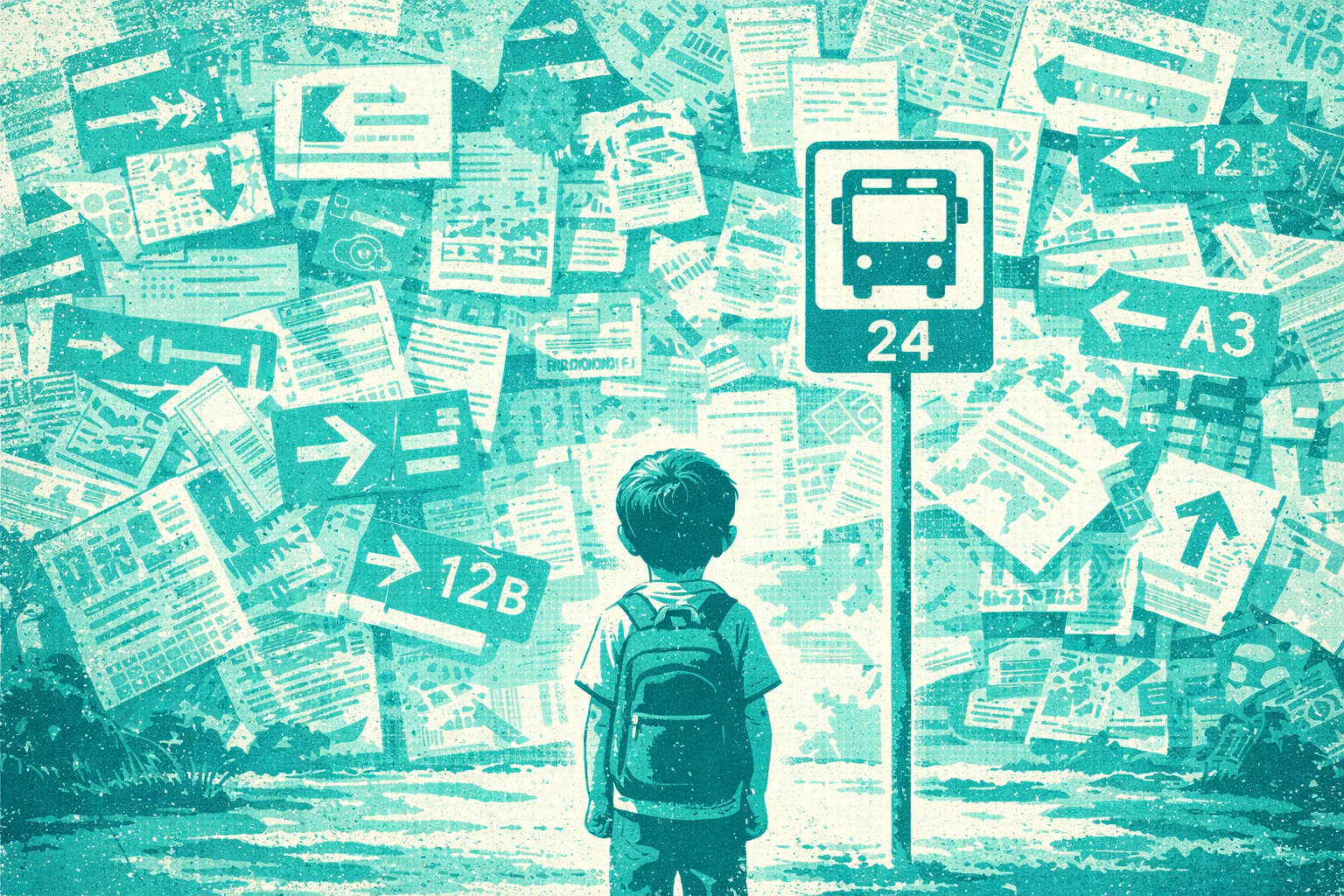
Imagine telling a child how to get home for the first time:
"Take bus 24 and get off at Oak Street."
That is enough to make the decision.
Now add everything else you know: the bus manufacturer, fleet maintenance schedules, route history, policy debates over transit funding, average passenger volume, and the color scheme from older vehicles.
None of that answers the real question: Which bus should I take right now?
The child does not fail because of too little information. The child fails because too much irrelevant information is competing with the signal.
That is increasingly where AI systems are headed to.
Why Agents Look Good - Until They Don't
Today's agents can look very strong in narrow workflows because the context is contained:
- the task is local
- the state is manageable
- the objective is clear
- signal outweighs noise
But as we push agents into larger systems, software execution, enterprise workflows, multi-agent pipelines, industrial operations, the context footprint grows fast. Now the model is carrying far more than one task:
- prior instructions
- retrieved documents
- tool output artifacts
- interim plans
- outdated assumptions
- historical state
- temporary decisions that were never meant to persist
This is where failure modes become subtle. The model does not necessarily become "dumber." It becomes contaminated by residue.
The Real Problem Isn't Memory, It's Memory Hygiene
Humans do not keep every thought equally active forever. We forget, compress, prioritize, and re-activate when needed. Good judgment depends as much on what we ignore as what we recall.
AI systems need the same capability.
Large context windows are useful. Retrieval is useful. Long-term memory is useful. Tool use is useful. But none of these solves the deeper issue by itself. If we keep increasing what a system can access without improving how it filters and decays context, we may not just build more capable systems.
We may build more confused ones.
Context Engineering Is the Next Layer
I think the next important layer in AI design is context engineering: not just expanding access to information, but controlling what participates in reasoning.
That means explicit choices about:
- what stays active
- what fades
- what gets retrieved only on demand
- what remains local to one workflow
- what gets compressed into durable state
- what should never enter the loop in the first place
Detox of Context Pollution
The next era of agentic systems will be multi-agent by default.
You won't have one agent doing everything. You'll have specialized sub-agents, each handling a narrow job, handing off outputs, and coordinating toward one shared goal.
That only works if context is managed properly.
Each agent needs two layers:
- shared context for cross-agent coordination
- local context for task-specific execution
If every sub-agent keeps dumping full historical state into the shared layer, the system will collapse under context bloat. Decision quality drops, handoffs get buggy, and agents start optimizing for stale assumptions.
So the real requirement is context hygiene, not just more memory: relevance filtering, context detox, and selective context sharing by default.
Human reasoning works the same way. We don't keep everything active forever. We forget what's irrelevant and preserve what matters now.
So the real challenge ahead is not only memory scarcity. It is memory hygiene.
The teams that solve this won't just build agents with more memory. They will build agents with better judgment, systems that know what matters now, not just what happened before.
At @locusgraph, we're exploring this same problem from a practical angle: how to progressively detox context so systems reason without carrying unnecessary residue.
Because intelligence is not just the ability to hold more context. It is the ability to know what to keep, what to ignore, and what to let go.